AI will never take the jobs of the humans it can't replace.
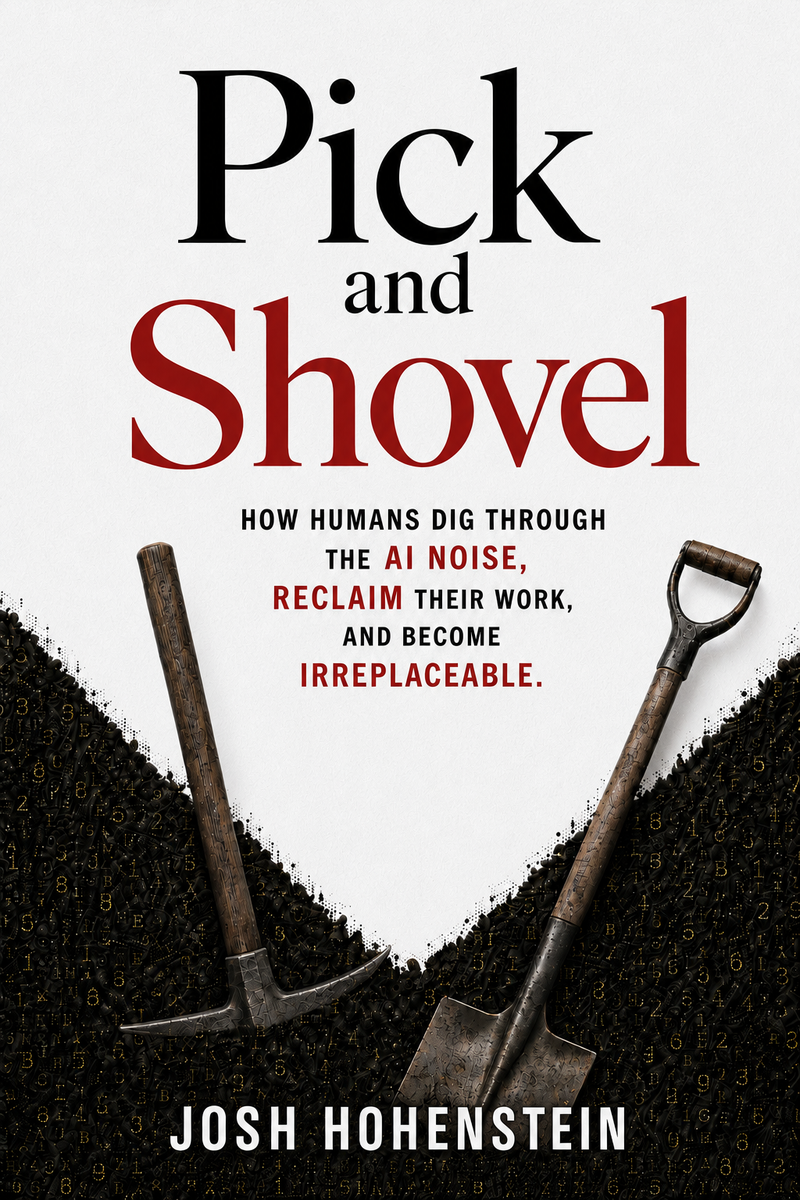
Pick and Shovel is the field manual for deploying AI inside your business the right way — so you cut through the hype, reclaim your week, and become the one person the technology makes more valuable, not less.
- Walk away knowing exactly what to do Monday — a friction-first system you run in an afternoon, not a six-month “transformation” that dies in a slide deck.
- Kill bad AI deals before they cost you — five questions that stop a seven-figure mistake before it guts the knowledge your business actually runs on.
- Turn AI into leverage for your people instead of a threat to them — and make yourself the one person nobody can automate away.
By Josh Hohenstein · Prometheus Press · Service-Disabled Veteran-Owned
It's 11 PM and the question won't shut up.
You just closed the tab on the third AI keynote this month. Your team is still doing the same work the same way it did last year. The board keeps asking what your “AI strategy” is. You've saved a dozen articles you haven't read. And underneath all of it is the question that actually keeps you up:
If I don't figure this out in the next twelve months, am I obsolete? And if I do figure it out — am I the one who teaches my company how to replace my own job?
That question is why you're on this page. Not the cover. Not the author bio. The question. So let's take it seriously, because the people pitching you AI have an enormous financial interest in you never answering it clearly.
Here's what they sold you. A McKinsey or BCG or vendor deck that quoted the Goldman Sachs “300 million jobs at risk” number, multiplied your headcount by your average salary, and showed a savings line that made your board smile and your gut clench at the same time. Eighteen to thirty-six months to “transformation.” Seven figures of fees. A future-state org chart with materially fewer people on it.
You took it home. Later that week you opened ChatGPT or Claude, typed a prompt that approximated something your team actually does, and looked at the output. It was competent. Not magic. Not nothing. And you were left exactly where you started — knowing AI matters, with no idea what to actually do on Monday.
That gap — between “this clearly matters” and “here is the specific thing I do next” — is the most expensive gap in business right now. The strategy decks don't close it, because the strategy layer assumes you already know what AI should do in your business before you've used it on anything. You don't. Nobody does. Not even the people building the models.
Pick and Shovel closes the gap from the other end. You don't start with strategy. You start with friction — the report assembled by hand every Monday, the email drafted from scratch that follows the same five patterns, the document written from a blank template when last quarter's version is sitting in a folder. You pick one. You build the simplest possible workflow in an afternoon, not a quarter. You measure honestly. You stack the next one. After eight or twelve of those, your team's capacity has visibly shifted — and you've learned what AI does in your business by deploying it, not by debating it.
And here's the part the savings-line pitch can't price: done right, this doesn't hollow out your people. It frees them for the work only humans do. That's the whole argument of this book, and it's the difference between AI deployed by greed and AI deployed by people who intend to still be standing — and still be irreplaceable — on the other side of it.
You've been sold AI a dozen times.
You still don't know what to do.
You've sat through the McKinsey / BCG / vendor pitch — the Goldman “300 million jobs” slide, the headcount-times-salary savings line, 18–36 months to “transformation,” seven figures of fees.
You opened ChatGPT, typed a real task, and the output was… competent. Not magic. Not nothing. And you still didn't know what to actually do.
Every “AI strategy” deck assumes you already know what AI should do in your business before you've used it on anything. Nobody knows that yet.
You're scared that doing nothing falls behind — and that doing the wrong thing guts the institutional knowledge that makes your business actually work.
The problem was never the technology. It was that nobody gave you a framework you could actually run.
Build the picks and shovels that accelerate and empower you.
AI is the gold rush of our time, and the frontier labs own the mines. Most people will spend the next decade chasing gold with tools they rent and don't control — one platform change away from starting over. The play that actually compounds is the opposite: build your own picks and shovels — the workflows, systems, and judgment that accelerate you, your business, and the people in your ecosystem, and that no vendor can take back. That work is what makes you irreplaceable. That's why the book is called what it's called.
A framework you can run on Monday.
The Pick & Shovel Approach — why you start with friction, not strategy, and the exact afternoon-long loop to stack your first 8–12 automations.
The Five-Question Diagnostic — run any AI pitch (or your own idea) through it before you sign. It kills bad deals in five minutes.
The Six Things humans bring that AI structurally can't — and how deploying AI well frees your people to do all six.
Eight function playbooks — Marketing, Sales, Support, Operations, Finance, People/HR, Engineering, and Executive — with concrete before/after workflows.
The Math by Business Size — what the gain actually looks like from sub-$5M to $250M+, in expense reduction and revenue.
The 12-Week Acceleration Program — the week-by-week deployment plan: Audit & Pick, Build & Pilot, Expand & Connect, Redirect.
What AI structurally can't do.
Deploy AI well and you free your people to do all six. That's the whole game.
Originality
Making what wasn't in the training data — the angle, the product, the strategy that doesn't pattern-match.
Judgment
Deciding under uncertainty with everything that isn't written down. The call is yours because the consequences are.
Integration
Holding every stakeholder, constraint, and timeframe at once and finding the path that survives all of them.
Presence
Being in the room with a problem that can't be solved — and carrying the weight the words wrap around.
Belonging
Owing and being owed. The 20 minutes after a layoff that decide whether your best people stay.
Attention
The kind of looking at a person that changes the thing being looked at. No system does this.
Run any AI pitch through this before you sign.
Five questions. They handle ninety percent of the deals that land on your desk. The pitch wants you to skip them and look at the savings number. Don't.
Who, when you remove or restructure them, won't be missed until month four?
There is always one. Sometimes several. Not your worst performer — that person was already being routed around. The one who quietly catches what nobody else catches: the customer who's been bothering them for two months, the vendor trying to slip a price increase past you, the new hire whose first quarter could go either way. Find that person before you sign the pitch. If the pitch doesn't account for them, the pitch is wrong.
What is the half-life of institutional knowledge in your business?
For a ten-year-old business at the $20–50M scale, it's two to three years. Half of what makes your business work is not written down anywhere, and within a few years half of that will walk out the door for natural reasons. Accelerate the half-life — layoffs, AI that displaces senior people — and you lose it faster than you can replace it. The savings the pitch promises do not include the cost of losing the half-life faster.
When the customer you've had for twelve years finally escalates, who do they trust?
The answer is never the AI. It's a specific person on your team. Sometimes two or three. The trust between them and that customer is a balance-sheet asset the pitch didn't price — and the first thing you destroy when you optimize the human out of the relationship.
What is actually being claimed here, in language that survives a literal reading?
The pitch is full of soft claims. “Productivity uplift.” “Headcount reduction opportunity.” Make the presenter restate each one as a literal sentence: “The marketing team will produce 20% more output with 30% fewer people, sustained 18 months, with CSAT holding.” Then test it. If they won't restate the claim that literally, they don't believe it — and neither should you.
What's the cost of error if this goes wrong, and is that cost recoverable?
A bad marketing campaign is small and recoverable in a quarter. A bad customer-service deployment that loses a major account is large and only partly recoverable. A finance controls deployment that misses a fraud signal is large and not recoverable. Match the configuration to the cost of error. High-cost, irrecoverable failures should never run on AI without real human supervision. Full stop.
The same week, given back to your people.
Part Two of the book walks every function — Marketing, Sales, Support, Operations, Finance, People, Engineering, Executive. Here's the shape of it.
Tier-one support
AI drafts the first response and pulls the account context, so the agent spends their attention on the cases that actually need a human — and the customer gets a faster, better answer.
Operations manager
Six hours a week of manual engagement-status reporting collapses to one. Projects at risk surface earlier. The manager spends the recovered time on the engagements about to go off the rails.
FP&A lead
Monthly variance analysis drops from four days to two. The board model gets sharper, not thinner, because the analyst is doing judgment work instead of assembling spreadsheets by hand.
Talent acquisition
Screening and scheduling stop eating the week, so the recruiter spends real time with the candidates and hiring managers where the actual hiring decision gets made.
Software engineer
Boilerplate, tests, and first-draft docs get handled by the model. The engineer ships more of the work only they can architect — and reviews what the AI got confidently wrong.
The executive
Instead of a leadership team arguing about an “AI strategy” in the abstract, every function has shipped something real and can show the time it recovered. The strategy answers itself by existing.
Know your number before you spend a dollar.
Chapter 14 sizes the gain by revenue band — conservative, defensible, and yours to run before any vendor quotes you a fee.
From “something's off” to a team that runs it without you.
Not a six-month transformation with a steering committee. A twelve-week deployment with documented results. The full plan is in the book — here are the four phases.
Audit & Pick
Your leadership team reads Part One — the actual chapters, not a summary. By Friday of week one each leader can answer three questions in writing or they haven't done the reading. Then each function audits how its team actually spends the week (not the org chart version) and brings three candidate automations: work that happens often, that the team does grudgingly, where getting it wrong is recoverable. You pick one per function and document the starting state so you can measure the gain.
Build & Pilot
One person builds — not a committee, not a vendor. Ideally the person who does the work today, because they know what good output looks like. Six hours, a rough first prompt, tested on real examples. The leader's only job is to remove obstacles and not ask for status more than once. By week five it's running in production on real work, measured against the starting state. By week six every function has at least one workflow live with documented results — or an honest post-mortem of why the first attempt didn't. Both are progress. Silence is the only failure.
Expand & Connect
Second and third automations go faster because the team learned the pattern. The first-round builders become the internal experts and mentor the next ones. Patterns start jumping functions — the reporting workflow in finance maps to operations; the model usage in marketing applies to sales. A thirty-minute cross-function sync makes the learning visible, and that's where the compounding starts. Recovered time becomes measurable in specifics: call summaries in three minutes instead of fifteen, variance analysis in two days instead of four.
Redirect & Document
The phase most businesses skip — and lose the value because of it. Recovered time that doesn't get explicitly redirected gets reabsorbed by Slack, meetings, and busywork. Each leader sits with their team and assigns where the time goes: the strategic work, the customer-facing work, the building you never had room for. Then you document the whole system so it survives after the outside help leaves. The output isn't a deck. It's a team running the framework with confidence on its own.
The framework, applied. Real numbers.
added revenue in year one — $30M professional-services firm
incremental ARR + $2.4M retained — $100M B2B SaaS
EBITDA improvement — $500M industrial company
strategy-firm engagement avoided — same result, framework instead
Composite case studies drawn from real engagements; identifying details altered.
The whole kit. One free download.
Pick and Shovel — The First Edition
- The complete framework across 15 chapters and three parts — Doctrine, Functions, and Execution — written for the person actually on the hook for deploying AI, not a theorist on a stage.
- The Pick & Shovel approach in full: start with friction, build the simplest workflow in an afternoon, measure honestly, and stack wins until your team's capacity visibly shifts.
- The Six Things humans bring that AI structurally can't — and exactly how deploying AI well frees your people to do all six instead of quietly replacing them.
The Five-Question Diagnostic
- The five questions that kill a bad AI deal in minutes — before you sign a seven-figure engagement that guts the knowledge your business actually runs on.
- A built-in lie detector for soft claims: it forces every “productivity uplift” to be restated as a literal sentence you can hold someone to and test.
- A way to match each deployment to its true cost of error, so the irrecoverable failures never run on AI without a human in the loop.
The 8 Function Playbooks
- Marketing, Sales, Support, Operations, Finance, People, Engineering, and the Executive function — each with concrete before/after workflows you can lift directly.
- Real anchor scenarios — the support agent, the ops manager, the FP&A lead — showing where the hours actually come back and what the human does with them.
- Built as a Monday-morning reference, not a lecture: skip straight to the function you own and start running it the same day.
The 12-Week Acceleration Program
- The exact week-by-week plan an outside team would charge six figures to run: Audit & Pick, Build & Pilot, Expand & Connect, Redirect & Document.
- Who builds, how many hours, what to measure, and the cross-function syncs where the compounding starts — all spelled out so you can run it without us.
- Ends with your team running the framework with confidence on its own — not a strategy deck that gets reviewed once and shelved.
The Math-by-Size Model
- Conservative, defensible gain estimates by revenue band — from under $5M to $250M+ — in both expense reduction and revenue upside.
- Know your number before a single vendor quotes you a fee, so you negotiate from data instead of from fear of falling behind.
- The same logic behind the case studies that produced $1.8M in new revenue, $3.6M in ARR, and $19M in EBITDA — sized to you.
Josh Hohenstein
Ten-year U.S. Army Infantry combat veteran. 75th Ranger Regiment. Founded and exited a multi-disciplinary consulting firm. Generated over $50M in client value and shipped 750+ AI deployments into production. He wrote this book because his kids will inherit a world powered by AI — and he wants it deployed by love, not greed.
If the first chapter doesn't change how you think about AI in your business, close the tab.
It's free. There's no risk and no catch — use the parts that help you whether or not we ever speak.
Fair questions.
Is this just an ad for your consulting firm?
No. It's the actual framework, in full. The book ends with how to work with Prometheus if you want help — but it's written so you can run the whole thing yourself and never call. The argument stands on its own merits, not mine.
Is it too technical? I'm not an engineer.
It's the opposite. There's no code. It's written for the person responsible for deploying AI — CEO, function leader, founder, independent professional. If you can write an email, you can run the Pick & Shovel approach.
My business is small / huge. Does it apply?
The framework speaks to 100% of businesses, not a revenue band. Chapter 14 spells out the math from sub-$5M to $250M+. The approach scales down to a solo practice and up to a $500M operation.
Will this be outdated in six months?
The tools will change. The framework won't — it's about how humans and AI divide the work, which doesn't expire. That's the whole point of picks and shovels over chasing the gold.
What does it cost?
The digital First Edition is free — enter your name and email and we'll send it. If you'd rather we run the 12-week deployment with you, that's the consulting engagement, and you can book a call.
Get the First Edition. Free.
Enter your name and email — we'll send your copy. Then go do the work.